Strategic Alignment
The Information Security Road Map is strategically aligned with the McMaster IT Strategic Plan towards the achievement of McMaster’s overarching strategic priorities.
McMaster IT Strategic Pillars
A Connected McMaster Community
McMaster’s cooperative and transparent approach to prioritizing and funding information technologies for the institution will include aligned leadership and partnerships across campuses, allowing the institution to reach its highest potential by drawing on the expertise of our talented IT community, enabling engagement, adaptability, and connections at all levels of the institution.
Key Objectives
- Institutional Adaptiveness
- One IT Community
Seamless Foundation
A standardized, scalable, secure and integrated technology infrastructure is the necessary foundation for transformative information technologies and services at McMaster. This ‘rock solid’ and seamless environment of core capabilities will be fostered through coordination across IT service areas and will provide McMaster with valued and high performance information technologies.
Key Objectives
- Optimized IT Infrastructure
- Enhanced Productivity Systems
Transformative Information Technologies and Services
McMaster‘s evolution as a 21st century institution will depend on strategic solutions based on leading edge technologies and innovations, and investments in strong data integrations and automation tools to create ‘delightful’ technologies and world class experiences for students, faculty and staff.
Key Objectives
- Expedited Collaboration and Decision Making
- Reimagining the McMaster IT Experience
Accountability and Decision Making
Information Box Group
Enterprise IT Security Accountability
Enterprise IT Security Accountability sits with the Vice President Administration, the AVP and Chief Technology Officer (CTO), Directory of Information Security Services (ISS) and her IT Security team.
McMaster BoG Audit and Risk Committee
Regular IT security updates include any incidents, monitoring, and changes at each meeting throughout the year.
IT Governance
The IT Security Roadmap and each initiative therein will be reviews and endorsed through the IT Governance Standing Committees. Any new IT Security Roadmap initiatives will be reviewed and endorsed by the UT Executive and will be presented to President and Vice Presidents, Deans, etc. Any new IT Security initiatives are to be presented to McMaster BoG Audit and Risk Committee.
Information Security Governance
Objectives
To determine the appropriate IS Governance Approach and Structure for McMaster that:
- Define and reinforce clarity of intent and direction Responsibility for Information Security and its strategic alignment.
- Establish clear lines of authority and responsibility for delivery, reporting and escalation.
- Provide a platform for Institutional Oversight ensuring consideration of information security risk tolerance.
- Ensure independent oversight over the implementation and management of the security program and roadmap.
- Optimize Security Value Delivery.
Scope
Includes appropriate senior leadership at the level of the Institution that sets the risk appetite and tolerance for information Security Risk; separate from the existing IT Governance and Audit and Risk Committee Oversight.
Deliverables
- Governance Approach and Structure Proposal.
- Stakeholder engagement.
- Governance Artifacts – charter or terms of reference, annual agenda plan.
- Implementation and Operationalization plan.
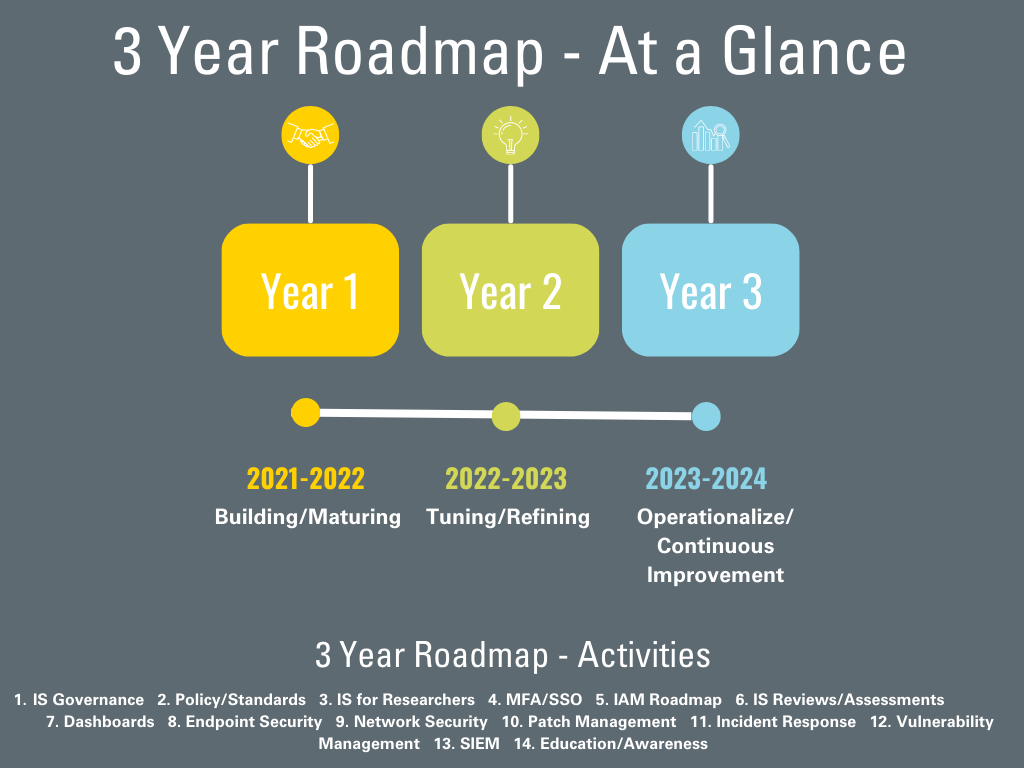
Roadmap Activities